
Personalised bedtime stories · Lullabies · Sleep sounds

The voice they love most, at every bedtime.

Record your voice once, and NubiNook reads every bedtime story in it, starring your child, their favourite pet and the adventure they pick tonight. Stories, lullabies and sleep sounds are made to calm, so bedtime can end with your child drifting off on their own.

Coming soon on theApp Store Coming soon onGoogle Play

Built on published research in child development and sleep science.

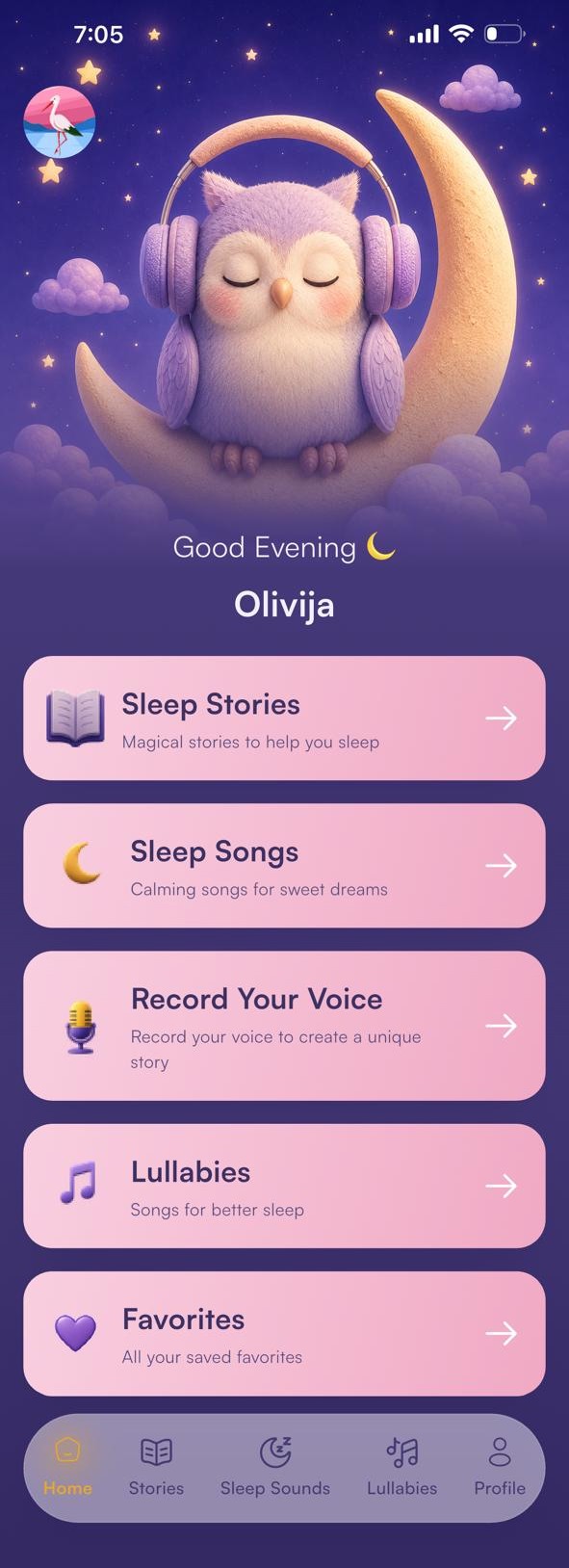
The NubiNook app home screen: Sleep Stories, Sleep Songs, Record Your Voice, Lullabies and Favorites

97%

of children recognised their mother's voice from a clip under one second long.1

80%

of newborns fell asleep within 5 minutes to gentle white noise, vs 25% without it.2

10,085

children studied worldwide: every extra night of bedtime routine meant better sleep.3

1.4M

more words heard by age 5 by children who are read to every day.4

How it works

Set up in minutes. Bedtime handled every night.

  1. 01

    Record your voice

    Read a short script aloud once. Mum, Dad, Grandma and Grandad can each add their own voice.

  2. 02

    Personalise the story

    Add your child's name, their favourite pet or toy, and pick tonight's theme.

  3. 03

    Press play and set it to loop

    The story plays in your voice and flows into a lullaby or soft sleep sounds, on repeat for as long as needed.

  4. 04

    Say goodnight and step out

    Leave the phone playing across the room. Your child drifts off to your voice, on their own.

Our signature feature

A story written for them. Told by you.

Other apps read stories in a stranger's voice. NubiNook reads them in yours. Every story is shaped around your child, so each night feels like it was written just for them.

  • Who's reading tonight? Choose Mum, Dad, Grandma, Grandad or any family voice you've recorded.
  • Starring your child. Their name, their best friend, their favourite pet or cuddly toy.
  • Their choice of adventure. The ocean, a forest, the stars, snowy hills, a sleepy little train and more.
  • Always there. On late shifts, work trips or nights with the babysitter, your voice still says goodnight.

Tonight's story, read by Dad

"Once upon a time, when the stars were just waking up, Mia and her puppy Biscuit tiptoed down to the quiet silver ocean. The waves were humming a lullaby only they could hear…"
Child's nameFavourite petChosen themeFamily voice

Why it works

Every benefit, backed by research

We built NubiNook around what scientists have found about how children feel safe, settle and fall asleep.

For your child

< 3 days old

They know your voice before they know your face

Newborns just days old prefer their mother's voice to a stranger's. Even before birth, a baby's heart rate responds to its mother's voice differently from a stranger's.

DeCasper & Fifer, Science, 19805 · Kisilevsky et al., Psychological Science, 20036
< 1 second

A familiar voice lights up the brain

Children picked out their mother's voice in under a second. In brain scans, her voice activated far more of the brain than unfamiliar voices did, including areas for emotion, reward and social connection.

Abrams et al., Stanford University, PNAS, 20161

Voice = a hug

Your voice alone lowers stress

After a stressful task, children who only heard their mother's voice by phone had lower stress hormone (cortisol) and higher bonding hormone (oxytocin), matching children who got an in-person hug.

Seltzer, Ziegler & Pollak, Proc. Royal Society B, 20107

−88%

Eyes closed, screen away

One hour of bright light before bed cut melatonin (the sleep hormone) by about 88% in 3–5-year-olds. Children using devices at bedtime are about twice as likely to sleep too little. NubiNook is made for listening, not watching.

Akacem et al., Physiological Reports, 20188 · Carter et al., JAMA Pediatrics, 20169

Heart rate ↓

Lullabies relax the body

Infants' heart rate dropped and their pupils narrowed (both signs of relaxing) more during lullabies than other songs, even lullabies they had never heard. Familiar songs calmed upset babies better than talking.

Bainbridge et al., Harvard, Nature Human Behaviour, 202110 · Cirelli & Trehub, 202011

1.4M words

Stories grow language

Children read five books a day hear about 1.4 million more words by age 5 than children who aren't read to. Even one story a day adds around 290,000.

Logan et al., J. Developmental & Behavioral Pediatrics, 20194

For you

Loop & leave

They learn to fall asleep on their own

Set the story or lullaby to loop, say goodnight and leave the room. Children who fall asleep without a parent beside them tend to wake up less often during the night.

Sadeh, Mindell et al., Journal of Sleep Research, 200912

3 weeks

Calmer evenings, happier parents

In a study of 405 families, three weeks of a consistent bedtime routine meant children fell asleep faster and woke less, and mothers' mood and sleep improved too.

Mindell et al., Sleep, 200913

Every night

The routine holds, even when you're away

Each extra night a week with a bedtime routine was linked to earlier bedtimes, faster sleep and longer nights. With your voice recorded, the routine stays the same even when you can't be there.

Mindell et al., Sleep, 2015, 10,085 children3

Composed to calm

Sound designed for sleepy little minds

Every lullaby, sleep song and soundscape in NubiNook is composed around soft, low frequencies and slow, steady rhythms. These are the same qualities researchers find in lullabies all over the world. Stories are layered over the same gentle sound beds, so the whole experience winds down together.

  • Low, warm tones. No sharp highs or sudden changes that can startle a drowsy child.
  • Slow, steady tempo. A calm, predictable rhythm, like a slow heartbeat or a rocking chair.
  • Seamless loops. Sounds and lullabies repeat without a jarring restart, so nothing wakes them.
Nubi the owl listening with headphones, sitting on the moon

80% vs 25%

Newborns who fell asleep within five minutes with gentle white noise, compared with those without.2

144 babies

relaxed measurably to lullabies from cultures they'd never heard, suggesting lullabies speak a language babies already understand.10

Safe listening tip

Keep the volume low and the phone about 2 metres from the cot. Paediatric researchers recommend this for all sleep sounds.14

The NubiNook library

Stories, songs and sounds for every night

The Snug Little Mouse
The Littlest Train's Way Home
The Littlest Duckling and the Rocking Water

Sleep stories

Gentle, slow-paced tales that wind down instead of winding up. Every one can be personalised and read in your voice.

Lullabies & sleep songs

  • Little Drop, Rest
  • Nell's Light Will Tell
  • The Owls
  • Little Star
  • The Sleepy Train
  • Animals on the Farm
  • Little Fish
  • Sleepy ABC

Sleep sounds

  • Ocean
  • Forest
  • Wind
  • Snow
  • Crickets
  • Birds
  • Train
  • Planet
  • White noise

Coming soon Calm, bedtime-friendly games for winding down.

Privacy & safety

Your family's voice stays your family's

A voice is personal. We protect it that way.

  • Used only for your stories. Your voice reads to your child and is never used for anything else.
  • Encrypted and deletable. Remove your recordings at any time, straight from the app.
  • No ads, no data sold. Not now, not ever.
  • Parent-controlled. Grown-ups set everything up. Children just listen.

FAQ

Questions parents ask

How long does it take to record my voice?

Just a few minutes reading a short script aloud. After that, NubiNook can read the stories in your voice.

Can grandparents or other family members record too?

Yes. Anyone special to your child can add their voice, and you choose who reads each night.

Can I leave it playing and walk out of the room?

Yes, that's what it's designed for. Set the story, lullaby or sleep sound to loop, put the phone across the room with the screen off, and say goodnight.

What ages is NubiNook for?

Babies, toddlers and young children, roughly 0–8 years old.

Does my child need to look at the screen?

No. NubiNook is made for listening. Start the story, dim the lights and put the phone down.

Is NubiNook a medical or sleep-therapy product?

No. NubiNook is a bedtime companion built on research into family voices, routines and calming sound. If you're worried about your child's sleep, speak to your paediatrician or health visitor.

Say hello to Nubi

Meet Nubi, your child's sleepy little friend

Tonight, let your voice tuck them in.

NubiNook is coming soon to iPhone and Android.

Coming soon on theApp Store Coming soon onGoogle Play

Research references

  1. Abrams, D. A. et al. (2016). Neural circuits underlying mother's voice perception predict social communication abilities in children. PNAS, 113(22). Link
  2. Spencer, J. A. et al. (1990). White noise and sleep induction. Archives of Disease in Childhood, 65(1), 135–137. Link
  3. Mindell, J. A. et al. (2015). Bedtime routines for young children: a dose-dependent association with sleep outcomes. Sleep, 38(5), 717–722. Link
  4. Logan, J. A. R. et al. (2019). When children are not read to at home: the million word gap. Journal of Developmental & Behavioral Pediatrics, 40(5). Link
  5. DeCasper, A. J. & Fifer, W. P. (1980). Of human bonding: newborns prefer their mothers' voices. Science, 208(4448), 1174–1176. Link
  6. Kisilevsky, B. S. et al. (2003). Effects of experience on fetal voice recognition. Psychological Science, 14(3), 220–224. Link
  7. Seltzer, L. J., Ziegler, T. E. & Pollak, S. D. (2010). Social vocalizations can release oxytocin in humans. Proceedings of the Royal Society B, 277(1694). Link
  8. Akacem, L. D. et al. (2018). Sensitivity of the circadian system to evening bright light in preschool-age children. Physiological Reports, 6(5). Link
  9. Carter, B. et al. (2016). Association between portable screen-based media device access or use and sleep outcomes: a systematic review and meta-analysis. JAMA Pediatrics, 170(12). Link
  10. Bainbridge, C. M., Bertolo, M. et al. (2021). Infants relax in response to unfamiliar foreign lullabies. Nature Human Behaviour, 5, 256–264. Link
  11. Cirelli, L. K. & Trehub, S. E. (2020). Familiar songs reduce infant distress. Developmental Psychology, 56(5), 861–868. Link
  12. Sadeh, A., Mindell, J. A., Luedtke, K. & Wiegand, B. (2009). Sleep and sleep ecology in the first 3 years: a web-based study. Journal of Sleep Research, 18(1), 60–73. Link
  13. Mindell, J. A. et al. (2009). A nightly bedtime routine: impact on sleep in young children and maternal mood. Sleep, 32(5), 599–606. Link
  14. Hugh, S. C. et al. (2014). Infant sleep machines and hazardous sound pressure levels. Pediatrics, 133(4), 677–681. Link